
What the Fairfax County Current Owner Record Shows
On the DTA iCare card, the current owner of a Fairfax County parcel appears under the "Name" field. The card also carries the mailing address, the property location, a tax-map reference, the deed book and page, and the date of the last refresh. Together these fields tie the tax-roll entry to a recorded document. They say nothing about who lives there. One Vienna card names a public owner. It shows a Center Street mailing address, a Ross Drive situs, and a book-and-page citation. That entry is a useful field sample. It is not a typical private sale. Read the tax year and every address label before calling a name the current owner.
| Name | DTA's owner-of-record field, which may be withheld online on request. |
|---|---|
| Mailing address | Address used for tax correspondence; may differ from the parcel. |
| Property location | Situs address associated with the assessed parcel. |
| Tax-map reference | County parcel key used to cross-check other systems. |
| Book and page | Recorded-deed reference when shown on the card. |
| Last refresh | Date the card data was last updated. |
A mailing address is just a record field. It does not show where the owner lives. DTA refreshes ownership, sales, and physical characteristics twice weekly. Yet it promises no fixed lag after a closing. A deed just recorded in CPAN can outrun the assessment card. The Fairfax County sample card shows how the name and location fields are kept apart.
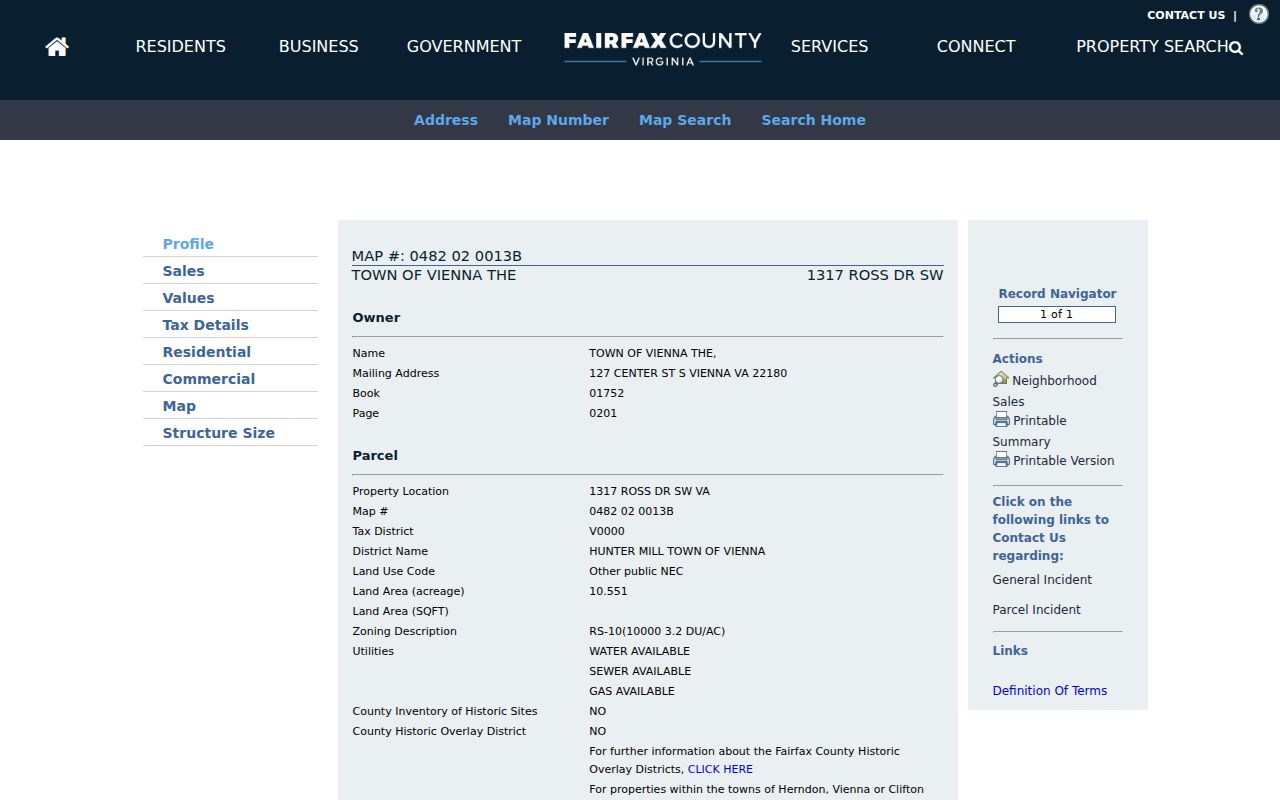
Verify the current owner with the parcel reference and deed citation, never an address guess.
The example here is unusual. It names the Town of Vienna as owner. It gives a Center Street South mailing address. It also lists a Ross Drive situs elsewhere. It also carries map reference 0482 02 0013B and deed book 01752 at page 0201. Those details show how a public owner, a taxpayer address, and the actual parcel location can differ. They can sit in three different places. Treat this public-body parcel as a demonstration, not as a model of a private home.
Confirm the Current Owner in Fairfax County
For a recent transaction, confirm the owner against the newest conveyance in Circuit Court CPAN. Fairfax County splits the tax roll and the deed across separate systems. The cross-check is direct. Compare the iCare owner field with the latest grantee on the deed. Then match the legal description and tax-map reference.
- Find the parcel in iCare and copy the name, tax-map reference, and book/page if displayed.
- Search the latest conveyance in CPAN and read the grantee and land description.
- Compare the deed's parcel description with the iCare location and map reference.
- If the named grantee is an entity or estate, use its exact legal form for follow-up.
- Owner of record
- The name shown in a custodian's ownership record.
- Grantee
- The recipient named in the latest recorded transfer.
- Recording lag
- The interval between recording and a later tax-roll refresh.
- Mailing address
- A tax correspondence field, not an occupancy field.
Twice-Weekly Updates Do Not Set a Closing Date
DTA updates ownership, sales, and property characteristics twice weekly. That schedule refreshes the current owner field often. Fairfax County publishes no fixed number of days between deed recording and a card update, though, so a just-completed sale can surface in CPAN first. Date your answer by its source. Say "owner shown on the DTA card last refreshed on" or "grantee named in a deed recorded on." That wording keeps the two records honest. It also explains a temporary difference to a buyer, seller, or family researcher instead of leaving them to assume an error.
CPAN Confirms a New Fairfax Conveyance
CPAN is the Fairfax Circuit Court's remote service for land records. Public terminal access is available at the courthouse. The system holds official recorded deed images from 1742 to the present. Pull the latest entry using the owner name, tax-map reference, or the book and page carried over from iCare. You can search by owner name. You can also use a tax-map reference. A book and page carried over from iCare works too. The deed's recorded date and grantee are the evidence to weigh against the roll. CPAN is not a title opinion. It displays official recorded documents. The reader must still inspect the instrument and confirm the same land. The current-owner check ends at the newest deed. Tracing each former grantor belongs to the backward chain of title.
Trusts, Estates, and LLCs Can Be Owners
An owner-of-record name in Fairfax County may belong to a person, an LLC, a trustee, or an estate. It may also belong to an executor or an administrator. The deed states the legal name and the role. For an LLC, the Virginia SCC's Clerk's Information System shows entity status and a registered agent. It also shows principal-office filings. It does not replace the recorded deed. For a trust or estate, a CPAN fiduciary or probate record may reveal who signed a later transfer. Never turn an agent, trustee, or executor into the owner. Match the instrument's grantee language, the tax-map reference, and the legal description. That matters most when a family name sits on the card while an entity sits on the deed.
Mailing and Property Addresses Differ
Fairfax County's iCare sample makes the address split concrete. A Town of Vienna owner carries a mailing address on Center Street and a property location on Ross Drive. The mailing address tells where tax correspondence goes. The situs address tells which parcel is assessed. Neither field alone proves occupancy. Keep both labels in view when comparing a recent deed or checking a card. A mismatch can be routine for a public owner, trust, estate, or company. Use the current deed for the grantee and the parcel reference for the land, and never treat a mailing address as an invitation to contact or locate a person.
Check Town Status for a Fairfax Address
An address that says “Fairfax” may sit in the county. It may also fall inside the independent City of Fairfax. The city runs its own government. It does not fall under Fairfax County taxation. Vienna and Herndon sit in a middle space. A town parcel can carry county tax records. But local zoning and historic-district rules add another layer of review. ZIP codes and postal city names never settle the question of jurisdiction.
Jade's political-jurisdiction field answers it quickly. When the card flags a town address, confirm historic status directly with the town. That habit keeps a county tax record from being confused with a town permit file. It also stops a City of Fairfax parcel from being routed to county assessment on the name alone.
When the Current Owner Is Not Displayed
A blank owner field has more than one cause. DTA withholds owner names from iCare at the owner's request. A hidden name does not erase the recorded deed, though. It only limits the public tax-card display. Match the parcel by address or map reference instead. Then turn to CPAN for the conveyance itself. Virginia's Address Confidentiality Program offers another reason. A public-facing address may not be a residence address.
Respect that limit. Fairfax County property data supports lawful diligence, tax review, and local history. It does not license a hunt for a private person through unrelated voter or motor-vehicle records.
When the owner field stays hidden, the deed index is a separate source. It can name the grantee in a recorded instrument. The same rule applies there. No privacy setting should be bypassed. No home address should be pieced together from unrelated data. Where an ownership question carries legal weight, ask the clerk or a title professional. They can identify the controlling public instrument.
Limits of a Fairfax County Current Owner Search
The current owner field is a dated snapshot, not a live answer. It can lag a freshly recorded deed. It may name a fiduciary or an entity. Or it may withhold a protected name entirely. Fairfax County records will not tell you who occupies the property. They will not settle a boundary dispute or guarantee clear title. Before a purchase, review the full deed chain with a qualified title professional.
Lawful use. Use Fairfax County ownership records for property research and due diligence. Do not use names or addresses to stalk, threaten, harass, or harm anyone.