
What Fairfax County Property Tax Records Show
Fairfax County property tax records have two related pieces: DTA's assessment and DTA Revenue's tax account. The assessment reports a parcel, owner field, land and building values, and physical characteristics. The account reports bills, payments, balance, and due dates. A property can have a public assessment card while its current payment status needs a separate tax transaction search.
DTA assesses real property each year at estimated fair market value as of January 1. That value is for the tax roll. A bill is the charge that follows the county's applicable tax rules and account activity; it is not the same thing as a recorded sale price. The fields below show where to look first.
| Field | What It Shows | Where |
|---|---|---|
| Land, building, total | DTA's annual assessed values for the selected tax year | iCare parcel card |
| Sales history | Visible sale dates and prices where available | iCare result panels |
| Tax relief | Program and exemption information | DTA exemptions page and parcel card |
| Bill and payment | Installment, balance, payment, and adjustments | MyFairfax or county payment tools |
| Delinquency or lien | Current account status and recorded instrument | DTA plus Circuit Court land records |
DTA's real-estate page explains the assessment program. Keep it separate from the payment account, and from the recorded deed CPAN holds, which may show consideration or transfer detail.
January 1 Sets Fairfax's Value Date
January 1 sets the value date in Fairfax County. The annual figure is an estimate of fair market value on that day. DTA studies neighborhood sales and property characteristics. The result lands on that year's assessment card. Value can move without any sale on the parcel itself.
Do not treat the number as a purchase quote. A sale price belongs to one transaction at one moment. An assessment reflects DTA's model and comparable sales. The county's method page explains how residential sales shape the annual figure.
The assessment landing page is the starting source for the current cycle and its records. Keep the year attached to every number, so comparisons never mix two January snapshots.
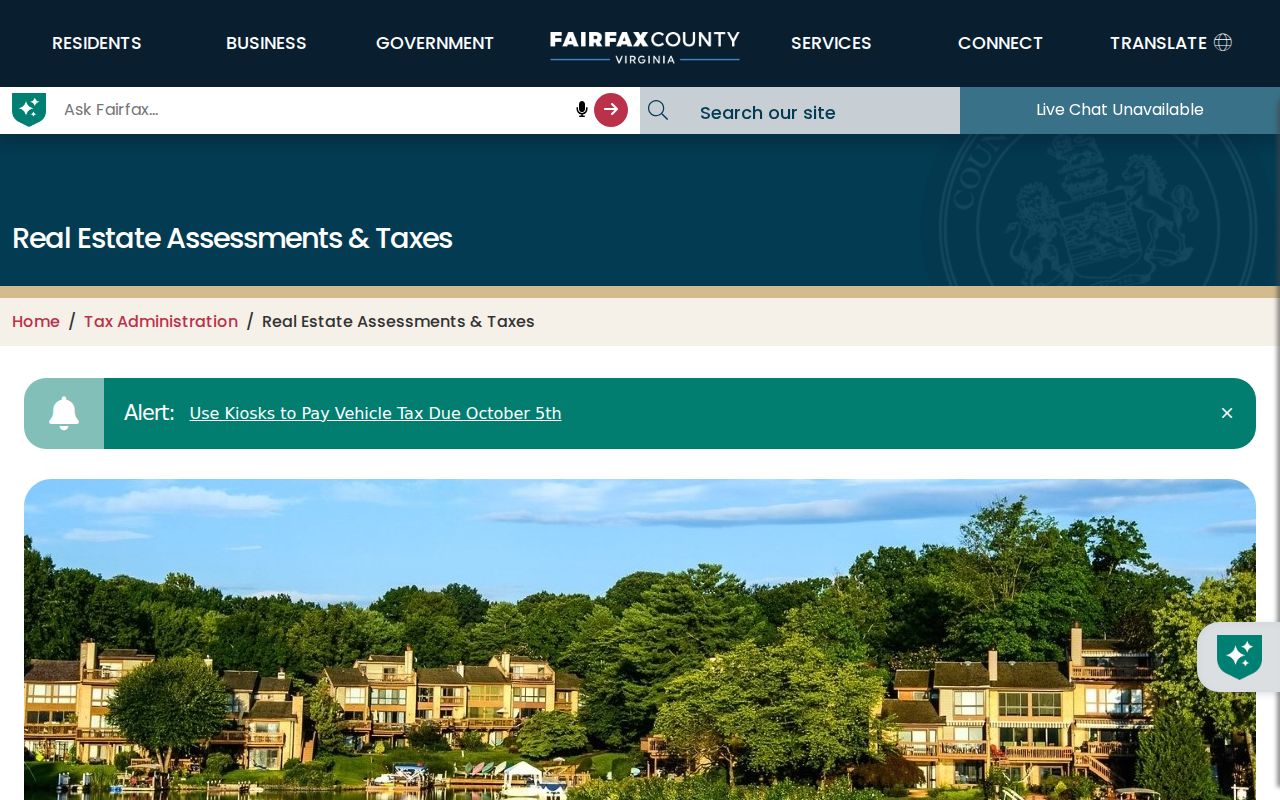
This screen is the annual assessment source. Reading the valuation field is only the first step; a bill or an appeal takes another.
Land, Building, and Total in iCare
Fairfax County's iCare card splits an assessment into three parts: land, building, and total. Those are DTA fields for the tax year shown. A card lists current land value. It lists current building value and an assessed total. It also flags whether an exemption applies. Use the property's own card, never a sample's amounts.
The assessment record also shows the description used to value the parcel. Zoning, land use, area, utilities, and structure facts can reveal a description error. For a tax review, note the disputed field and the year. One wrong physical feature can outweigh a general claim that the bill feels high.
Look Up a Fairfax County Tax Bill
DTA Revenue handles billing and payments for Fairfax County parcels. Use a bill stub number when you have one. Otherwise start from the county's property and tax tools. Then compare the result with the iCare parcel. Online details can lag a recent payment. DTA cautions that adjustments may not show right away either. So contact Revenue directly when a live balance matters to a deadline.
- Match the property using its address and tax-map reference in iCare.
- Open the county bill or payment service with the bill stub or account identifier.
- Read each installment and status, then note whether a mortgage servicer receives electronic billing.
- Check DTA Revenue by phone or email if a recent payment or adjustment is missing online.
- Assessed value
- DTA's estimate for the annual tax roll.
- Bill installment
- One of two scheduled portions of the county tax bill.
- Tax balance
- The account amount currently shown as due, subject to recent processing.
- Tax lien
- A claim that must be checked in the account and recorded-instrument systems.
Fairfax County Bills Come in Two Installments
Fairfax County bills real-estate tax in two installments. The due dates are July 28 and December 5. A weekend or county holiday pushes a date to the next business day. Keep both dates with the tax year.
The DTA billing page covers payment options and mortgage-company handling. A loan servicer may get electronic billing. That means no paper bill in the mail for the owner. A missing paper notice is not proof the account carries no balance.
Check the account through MyFairfax or the county payment page. Keep the bill stub number handy. If the display trails a recent transaction, DTA Revenue lists 703-222-8234 and DTARCD@fairfaxcounty.gov for follow-up.
Tax Relief Changes the Taxable Result
Fairfax County posts its real-estate tax relief and exemption programs through DTA. Check it for current eligibility and filing dates. Relief changes the tax account result. It does not rewrite the deed, sale price, or legal description. Keep the DTA response with the tax-year records.
Distinguish a tax exemption from a missing owner name. The parcel card shows whether an exemption applies. The privacy notice says DTA may withhold owner names online on request. Neither field changes the public record set held by the Circuit Court.
Use the official DTA exemptions page for programs and current application instructions. Never assume one year's relief decision carries into another.
A Tax Balance Is Not a Recorded Lien
Each tool answers its own question. The DTA Revenue screen reports the balance and payment status on a parcel's tax account, while CPAN indexes recorded instruments, including liens, releases, and judgments. Verify a balance with DTA. Check a recorded lien or its satisfaction in the Circuit Court record. The clerk keeps no auction list. Fairfax foreclosure guidance says a delinquency or foreclosure lead may require DTA, CPAN, a circuit civil case search, and local newspaper notices. An auction notice alone does not prove a transfer.
Recent Fairfax Payments May Lag Online
Recent payments can lag online. DTA warns that the display may miss recent payments or adjustments. Mortgage payments are the common culprit. Give the account display time to catch up. Then confirm the balance with DTA Revenue when accuracy matters. A saved screen is a snapshot, not a county receipt. Some records never appear online at all. For a bill copy, use the relevant DTA channel. The same goes for another existing county record. You can also make a focused request under Virginia FOIA. The county may charge actual search, copying, and production costs. VFOIA covers only existing records. It does not cover a newly built tax report.
Compare a Fairfax County Bill and Assessment
Read the assessment and the payment account together. They still answer different questions. An assessment supports the tax calculation, while the bill shows installments, payment entries, and the account balance. A parcel card may list a sale or value that helps explain the land record. A tax bill never documents the deed transfer.
- Use the parcel address or map reference to identify the correct DTA account.
- Record the tax year, land/building/total assessment, and any relief entry.
- Open the bill service and compare the July and December installment status.
- Confirm a recent payment or a possible lien with the office that maintains that record.
- Assessed value
- DTA's annual estimate of fair market value as of January 1.
- Taxable result
- The account figure after applicable relief and tax rules.
- Exemption
- A listed program that may reduce the taxable result when requirements are met.
- Tax lien
- A recorded claim to check in court land records as well as the tax account.
Appeal a Fairfax County Assessment
Fairfax County's 2026 appeal route ran through two deadlines. DTA review closed April 1. The Board of Equalization deadline followed on June 1. The county calendar lists each stage and its due date. A later Circuit Court appeal follows its own instructions. Confirm the dates for the tax year at issue. A missed deadline stays missed, no matter what a web search turns up. The 2026 application names three grounds: fair market value, lack of uniformity, and property-description error. It also asks for the tax-map reference, applicant and owner details. The form requires assessed land, building, and total values, and physical-characteristic checks. Each comparable sale needs an address, map reference, sale date, price, and comments. A general complaint that taxes are high is not a listed ground. The DTA and BOE appeal instructions set the calendar. Keep the notice, the filed application, comparable data, and any office answer together.
The deadlines shown are cycle-specific. Check the live county page for the next notice's deadlines and required submission method.
Appeal window. In the 2026 cycle, the DTA deadline was April 1 and the Board of Equalization deadline was June 1. Use the current county calendar for another tax year.