
Search Fairfax County Property Records
Begin with what you already know. An address is the easiest key. It usually opens the iCare assessment card. A tax-map reference is even tighter, because every county system reads that number. Names work too, but a deed may name a trust, an estate, or a company rather than a person. Try the shortest workable name form first. No one screen covers everything. Fairfax County property records answer different questions from different offices: the Circuit Court, the Department of Tax Administration, GIS, and Land Development Services each hold a slice. Start in iCare, then carry the map reference or book and page into the other offices, moving from the broad match toward the legal source.
- Enter the situs address in the DTA Real Estate Assessment Information Site, called iCare. The situs is the property location, not always the owner's mailing address.
- Copy the tax-map reference, owner name, legal description, and any deed book and page shown. Keep the spelling and punctuation as displayed.
- Open the parcel in Jade to check its map location, subdivision context, and nearby layers.
- Use the known grantee, map reference, or book and page in the Circuit Court's CPAN land-record system to confirm the latest recorded transfer.
- Use DTA tax channels or LDS address search for the bill, balance, permit, site plan, or certificate record those offices keep.
None of this replaces a title opinion. For a closing or a boundary dispute, read the deed and plat with qualified help.
Where Fairfax County Keeps Property Records
Fairfax County stores land information as a relay, not a single master property file. The Circuit Court records the instrument. GIS pins land to its map layers, while the Department of Tax Administration maintains the assessment roll. Land Development Services keeps development files. A deed can be recorded before the tax card shows the new owner of record, so follow the record instead of stopping at the first hit. Pick the office by the record. A deed proves what was recorded, an assessment card reflects the tax roll, a GIS layer adds spatial context, and a permit file tracks a development review. One office cannot fetch another's records.
Fairfax Circuit Court Land Records
4110 Chain Bridge Road, Suite 317
Fairfax, VA
703-691-7320
DTA Real Estate Division
Fairfax County Government Center
Fairfax, VA 22035
703-222-8234
DTA Revenue and LDS
Tax bills and development files
Fairfax County service channels
703-222-8234
Four Systems Shape Fairfax County Records
Treat the county's files as linked evidence. iCare says which tax parcel matches an address. Jade shows where that parcel sits and which planning layers cross it. CPAN reveals what the Circuit Court recorded, under which parties and reference. LDS tracks any construction or land-use review at the location. The four systems rarely move together. DTA refreshes ownership, sale data, and property characteristics twice a week. Yet it promises no exact delay after closing. A recorded deed may race ahead of the assessment card. The strongest bridge between systems is the tax-map reference. Deed legal descriptions and book/page references come next. Names alone are the weakest key. The recorded holder may be a trust, an estate, or an LLC.
- Grantor and grantee
- The grantor conveys an interest; the grantee receives it.
- Parcel
- A mapped tax unit, identified in Fairfax by a tax-map reference.
- Assessment
- DTA's value estimate for the tax roll, not a sale promise.
- Plat
- A recorded map that shows lots, blocks, and easements for a subdivision.
iCare Search Modes for Fairfax County Property
The iCare portal for Fairfax County offers three ways in. Address mode fits when a street location is known. Tax-map-reference mode works when a deed, notice, or earlier record supplies the county key. Map mode helps when the address is fuzzy. The parcel itself can still be spotted on the screen. Every route lands on the same assessment data. None of them substitutes for CPAN's recorded images. Address spellings vary. If autocomplete stalls, try the situs spelling or a shorter street form. A reference like 0482 02 0013B is a county key, not a street number. The public screen has no owner-name mode. For a known person or entity, match the parcel first. Then take the exact recorded name into the deed index.
| iCare mode | Search input | Good first use |
|---|---|---|
| Address | House number and street name/type | Start from a situs address, then verify the locality. |
| Tax map reference | Fairfax PIN, such as 0482 02 0013B | Match a deed, notice, or prior county record. |
| Map search | Select the parcel spatially | Resolve a location when the written address is incomplete. |
Read a Fairfax County Parcel Card
One name never tells the whole story. The sample iCare parcel card separates owner, mailing address, and property location. Below those, it lists the tax-map number, book and page, land area, zoning, utilities, historic flags, legal description, and a refresh date. In the example, the Town of Vienna holds title. The mailing address sits on Center Street. The parcel itself lies on Ross Drive. Those are three different links in one record, not one person's home. The sample iCare parcel card is a public-property example rather than a typical residential sale. Its value is the field layout. Save the tax-map reference and book/page, then carry both keys into CPAN.
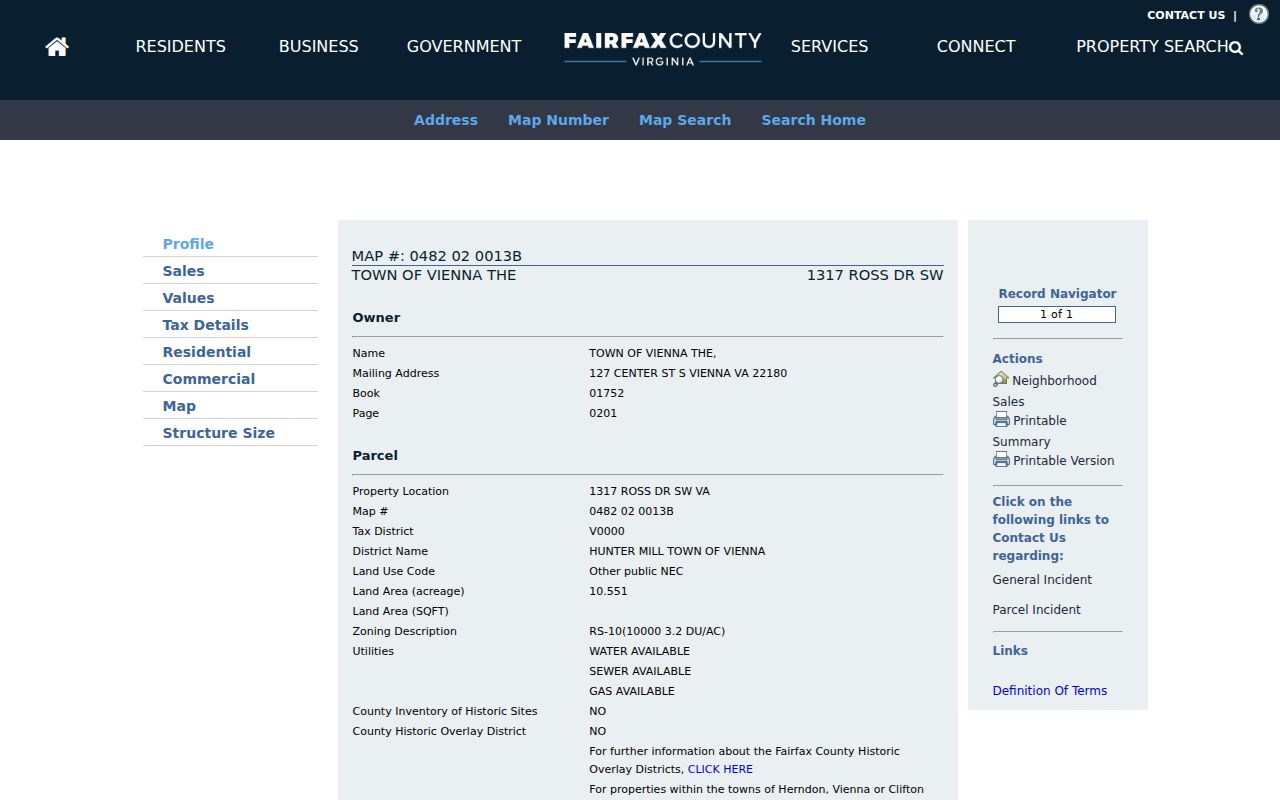
DTA data refreshes twice each week. Ownership, sales, and characteristics update on that cycle. No fixed deed-to-roll delay is published, so a recorded deed can appear in CPAN before the assessment card catches up.
CPAN's 1742 Fairfax Land-Record Reach
The Fairfax Circuit Court keeps the county's land records. The collection runs from 1742 to the present, with images digitized from books and microfilm. Index formats shift across that span. Current index data starts in 1980. Older index-book images cover 1742 through 1979. That line marks a format change, not missing deeds. CPAN, the remote subscriber service, costs $150 per user each quarter and requires user and entity agreements; the public research room offers terminals for self-directed work. The CPAN access page explains the subscription route and record categories.
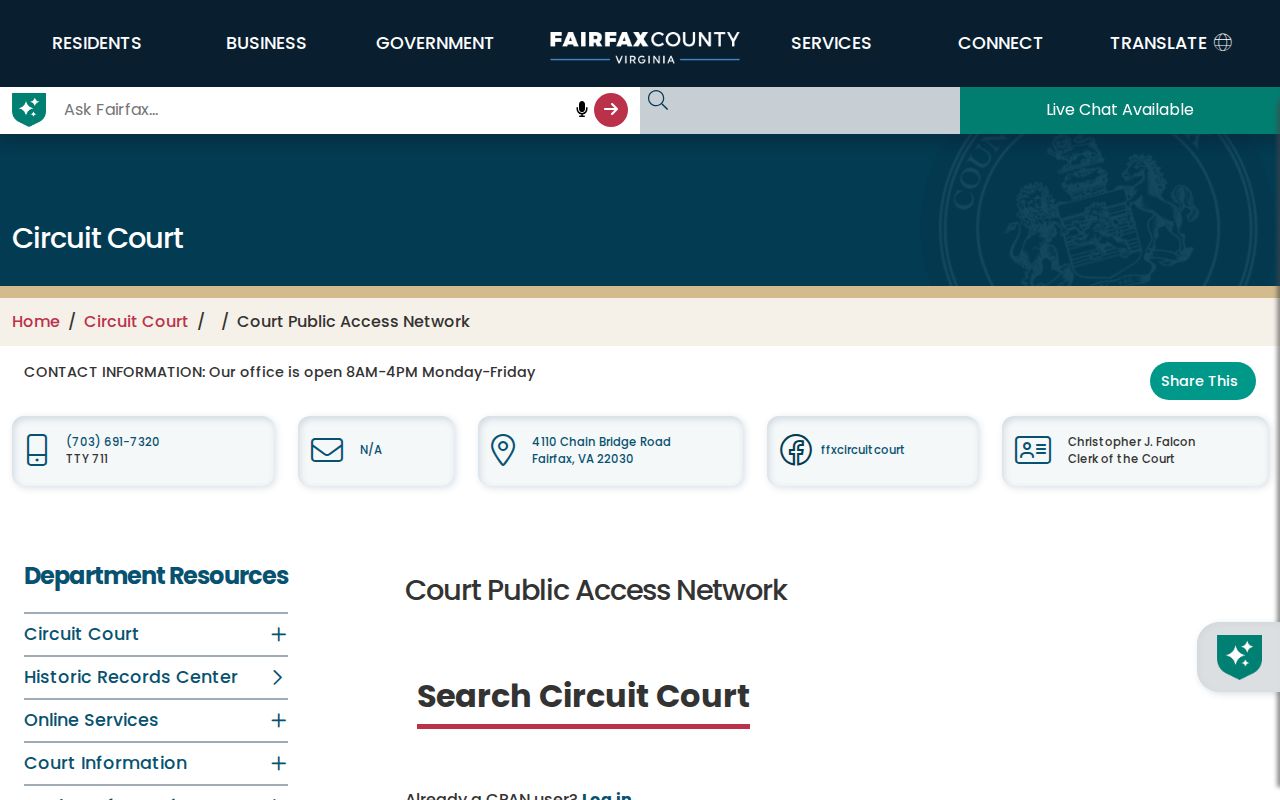
Deed books dated before 1945 fall under the Historic Records Center. Every book and reel of microfilm has been converted to images, according to the clerk. The searching itself stays with you. Staff will walk you through how the system works. They will not run a title search for you. Plan to trace the chain on your own.
Fairfax County Property Record Types
Fairfax County property records reach across legal transfers, taxes, maps, and development files. One parcel number can tie many of them together. But each office answers a different question, and no single record tells the whole story. A deed proves a transfer was recorded. It says nothing about payments, permits, or boundary calls. Match the record type to your question first. Then cross-check whenever ownership or land area is what matters most.
| Record Type | What It Documents | Kept By | Access |
|---|---|---|---|
| Deeds, liens, easements | Recorded interests and releases | Circuit Court Land Records | CPAN or public terminal; certified copies by request. |
| Assessment card | Owner, parcel, land/building value, characteristics | DTA Real Estate | Free iCare search. |
| Tax bill/account | Charges, installments, balance, payments | DTA Revenue | MyFairfax, payment site, phone, or request. |
| Parcel and plat | Map context, subdivision, lot, and plan | GIS; Circuit Court; Planning/LDS | Jade, recorded index, Site Records Viewer. |
| Permit and occupancy | Address-tied construction and land-use review | LDS or local town/city office | Online search; VFOIA fallback. |
Start with the Fairfax County deed-records page for the instrument trail. Tax bills and appeal steps live on the dedicated property-tax page instead. A Jade parcel, meanwhile, is a map guide rather than legal proof of a boundary.
January 1 Sets Fairfax County Assessments
DTA values real property each January 1 for the assessment year. The estimate reflects fair market value. The countywide figure is an annual mass valuation. It is not a private appraisal and not a buyer's offer. A property card may list land, building, and total values side by side. Its sale panel records a past deal, not a present one. Check the tax year and the field name before comparing any two figures. For the 2026 cycle, DTA mailed notices starting February 17. It set April 1 as the first appeal deadline. The Board of Equalization deadline followed on June 1. Fairfax County's appeal schedule and its assessment-method page lay out the process. Deadlines shift each cycle. So an old notice is a poor guide to the next calendar. Relief programs can change a tax bill without touching a deed or a parcel map. DTA lists programs for qualifying older residents, people with disabilities, veterans, and other groups. The current bill, payment, or balance still requires a separate tax-account check.
Jade Layers Around Fairfax County Parcels
Jade is Fairfax County's public GIS and analysis tool. It stacks more than 170 layers on top of current and historic aerial imagery. Parcel reports come with share, print, and export options. You can search by address, parcel number, intersection, or subdivision. Clicking a parcel opens either a general report or an environmental report. The environmental report covers watershed and floodplain details. It also lists resource-protection and soil details. The Jade launch page announced 2026 aerial photography and an improved Master Address Repository. Flipping through aerial years can show how a block changed over time. Each parcel report links a map selection to assessment, zoning, and land-use fields. It all appears in one place.
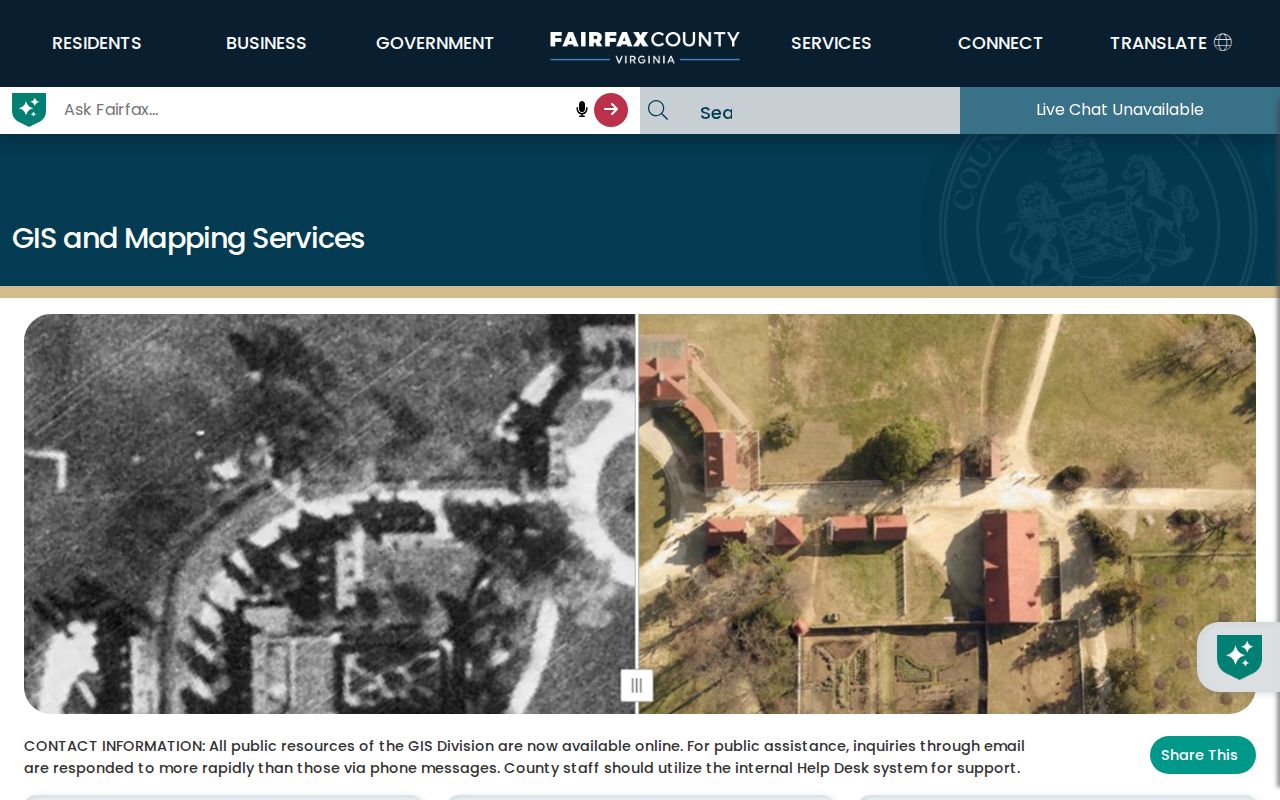
Orient your search with the map, never set a legal line by it. Fairfax County cautions that parcel geometry came from source methods of varying accuracy. Positions may not match survey-quality coordinates.
Fairfax City and County Address Lines
The name "Fairfax" points to two jurisdictions at once. The City of Fairfax is an independent Virginia locality ringed by the county. Fairfax County does not tax it. A mailing address reading Fairfax can still belong to county property. Herndon and Vienna are towns with their own zoning and historic review boards. County DTA and Circuit Court systems hold the county's property files. Sort out jurisdiction in Jade or the county address repository first. Ask your zoning or assessment question after that. A Vienna or Herndon parcel can show up in iCare. It may still need town confirmation for a local historic-district answer. The parcel's political-jurisdiction field and the town zoning map are stronger clues. Neither a ZIP code nor a mailing city settles the question.
LDS Permit Records by Fairfax County Address
LDS Public Records covers unincorporated addresses. It searches active construction sites, recent building permits, zoning applications, comprehensive-plan amendments, and certificates of occupancy. Site plans and plats sit in the Site Records Viewer instead. Anything missing online can be requested from LDS or filed through the county VFOIA form. The LDS address lookup offers another history trail. Remember that a permit records a project review, not ownership. The City of Fairfax and the incorporated towns run their own zoning and permit channels. Confirm a parcel's jurisdiction before calling any county search complete.
Fairfax County Access: Web, Room, Copies
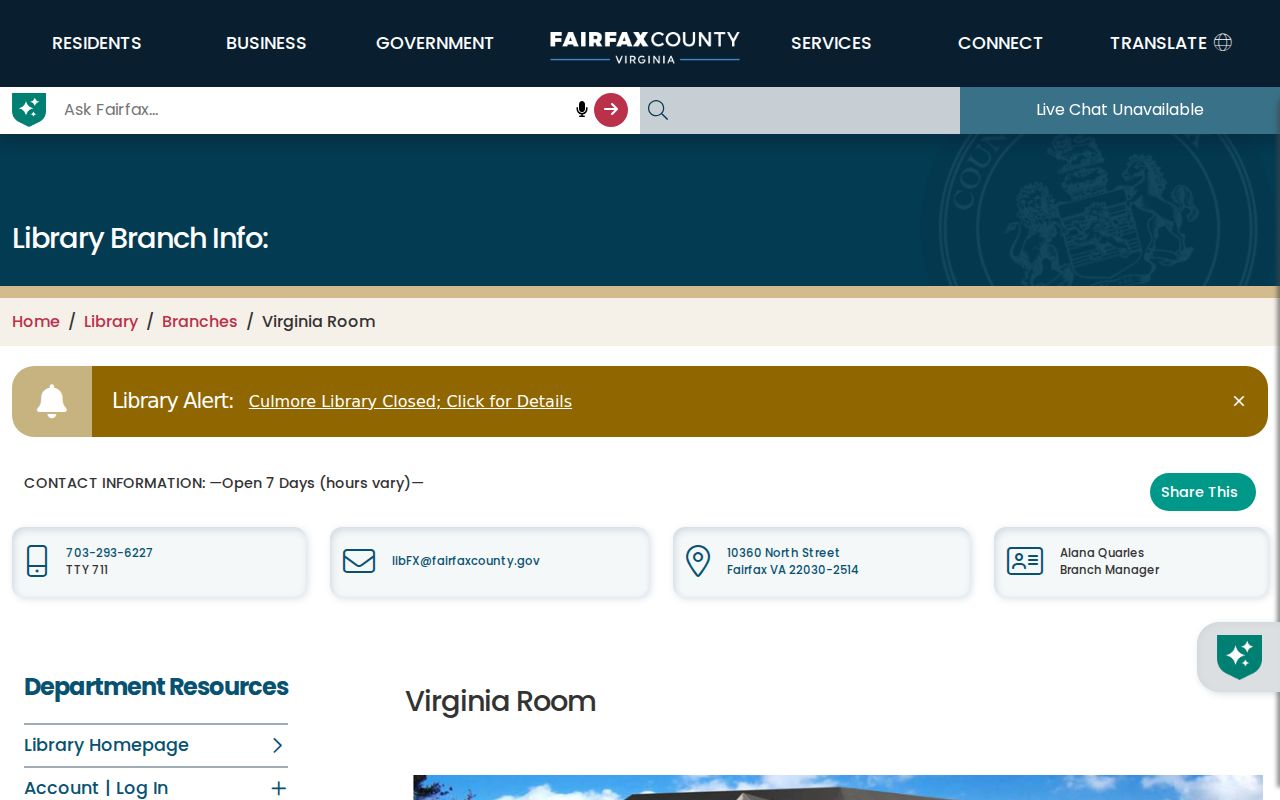
Online access comes in more than one flavor. iCare, Jade, and LDS search are free public web tools. CPAN remote access, by contrast, is a paid subscriber service. The courthouse research room offers terminals to anyone willing to visit. A certified land-record copy runs $2 per document plus $0.50 per page. The clerk takes several payment types in person. A mailed request needs a record reference, payment, and a stamped return envelope. Mailed copies go out within two weeks. The Fairfax County Public Library's Virginia Room holds local directories, newspapers, maps, photos, manuscripts, microform, a CPAN station, and a reader-printer that saves to USB. Those materials can link an old address to a family or subdivision history. Do that before you chase the deed chain.
County VFOIA is the fallback for existing files that never made it online. Its form asks for a name, email, and a description of what you want, and charges may reflect actual search, access, copying, or production costs. One limit matters here. VFOIA cannot force an office to create a new record or do research on demand.
Easement and Auction Leads in Fairfax
Mylar source documents never captured every easement, so the GIS easement layers in Fairfax County remain incomplete. Skip the map when you need certainty. The land-record route runs through CPAN, where the official instrument or plat shows what was actually filed. A layer can flag a possible issue. The deed book and the recorded image settle it.
Foreclosure sales work differently too. Fairfax County keeps no clerk-maintained auction list, and the Circuit Court FAQ directs readers to local newspaper notices for each sale's place, time, and contact. Search CPAN for deeds of trust, liens, lis pendens, or a final conveyance, then check DTA for the tax balance. One caution applies. A published notice is only a lead, not proof that the property changed hands.
Limits of Fairfax County Property Records
Fairfax County property records carry real weight. But they have limits. The assessor's roll reflects what that office has on file. A deed may change hands before the tax roll catches up. A line on a GIS map is a rough guide, never a survey. The assessed value is built for taxation, so it is not a market appraisal. For a purchase, an appeal, or a parcel dispute, these records are a strong start. They are not, on their own, a complete title opinion.
Lawful use. Fairfax County owner and parcel information is for lawful property research and civic use. Do not use it to stalk, threaten, harass, or harm a person; rely on a title professional or licensed surveyor when a purchase or boundary decision needs an exact answer.