
Find Who Owns a Fairfax County Property
Ownership evidence in Fairfax County runs from location to tax roll to recorded deed. iCare offers a useful owner-of-record field. That entry is a tax record, and it can lag behind a fresh transfer. CPAN's deed index supplies the official conveyance. Jade helps too. It checks that the address and tax-map reference point to a single parcel.
Start with an address. Copy the owner name exactly as shown. Then confirm the latest deed describes the same land. The owner may be an LLC, trustee, estate, or public body rather than an individual. This route identifies the recorded owner. It does not treat a mailing address as proof of who lives there.
- Search the situs address in DTA's iCare assessment site and copy the map reference and owner field.
- Open the parcel in Jade to confirm the county location and jurisdiction context.
- Search the exact name, map reference, or book/page in Circuit Court CPAN and read the latest recorded deed.
- If the grantee is an entity or estate, check its exact legal name and relevant court or SCC filing.
Do not stop at the first owner name. A parcel match plus a deed description is what ties the name to the land.
Where Fairfax County Owner Information Comes From
Fairfax County sources name owners in different ways. DTA's card lists the tax-roll name. CPAN records the grantor and grantee on each conveyance, which carries the official weight. Jade adds map context and may link to assessment details for the parcel. The State Corporation Commission explains entities, not land title.
| Record source | What the Name Means | Access route |
|---|---|---|
| DTA iCare | Tax-roll owner and mailing fields | Free public assessment search |
| Circuit Court CPAN | Parties to recorded conveyances | Public terminal or subscriber access |
| Jade parcel report | Map and linked assessment context | Free GIS viewer |
| Virginia SCC CIS | Entity status, filing, registered agent | Public business search |
Owner of record and occupant are different fields. A mailing address can differ from the parcel's situs, and iCare may withhold a public owner name on request. The recorded grantee proves a conveyance happened. It says nothing about who lives at the address today.
- Owner of record
- The name shown by a custodian's ownership record.
- Grantee
- The party receiving an interest in a recorded deed.
- Situs address
- The physical location tied to the parcel.
- Mailing address
- The address used for tax or owner correspondence.
The iCare Name Field Is a Tax-Roll Entry
The iCare card labels its owner field “Name.” The card may also show a mailing address and property location. Other fields include map number, tax district, land area, zoning, legal description, deed book and page, and a refresh date. Fairfax County DTA updates ownership, sale data, and physical characteristics twice each week. No exact deed-to-roll delay is published.
A recent closing can create a gap. For a short period, CPAN may show a newer grantee than iCare. Read both records. Let the newest recorded conveyance settle the timing mismatch. The assessment card still helps. It matches the parcel and identifies the correct book and page.
The sample Fairfax County parcel card separates a property on Ross Drive from a Town of Vienna mailing address.
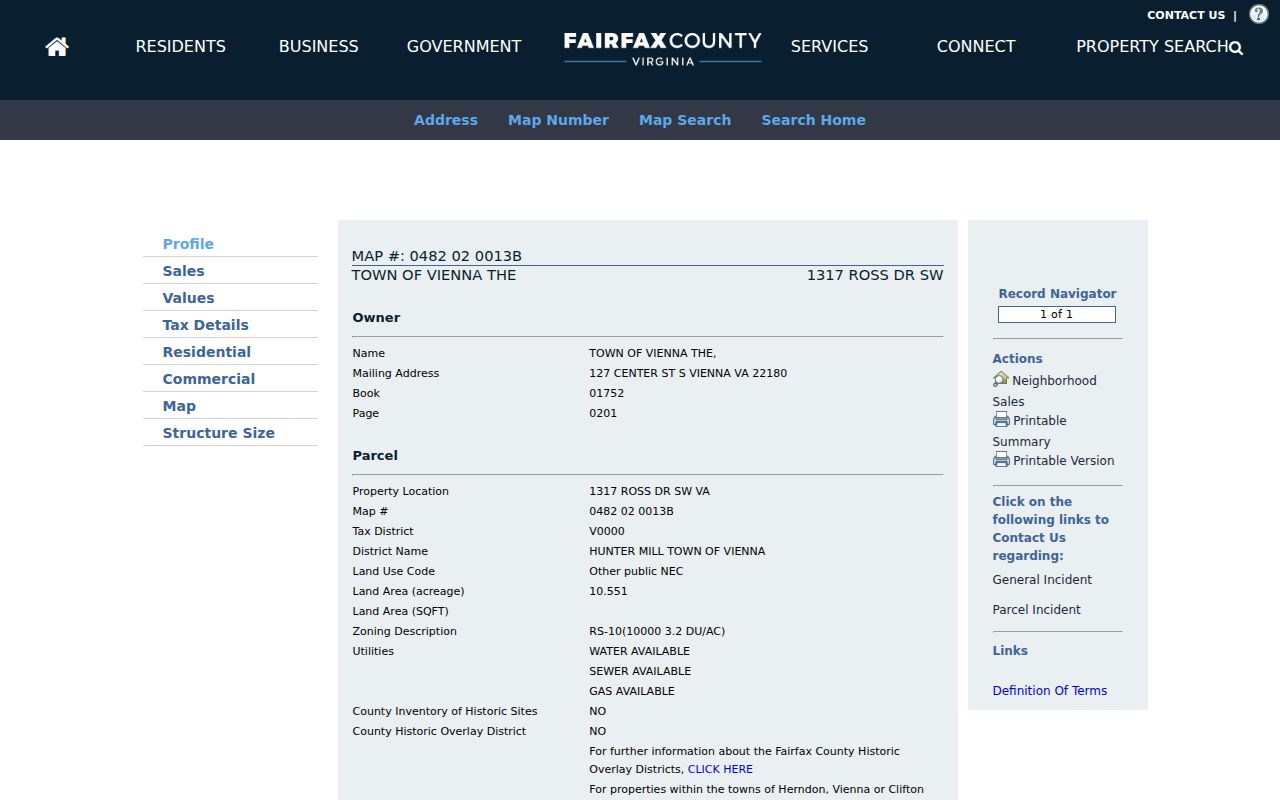
This sample names a public owner. Its lesson is how Fairfax County separates each field before the deed.
Confirm a Fairfax Owner in the Latest Deed
CPAN is Fairfax County's official land-record collection. Search the current grantee or the iCare book and page, open the newest conveyance, and compare its legal description with the parcel card. A party name alone invites same-name errors. The tax-map reference, property location, and legal description reduce that risk.
Fairfax deed images reach back to 1742. Newer index data and older index-book images cover different year ranges, so a failed electronic name search may still need the manual index books. The deed-records page covers the chain and copies. For this ownership check, CPAN only confirms the current owner.
Fairfax County Mailing and Situs Addresses
A Fairfax County owner may receive tax mail somewhere other than the property. The iCare sample shows the split. It lists 1317 Ross Drive SW as the property location and 127 Center Street South as the mailing address. That split helps when a name is common.
Keep both addresses. Preserve them with the tax-map reference. Then compare the deed address and latest tax year. Do not convert a correspondence address into a statement about where someone lives. If the name is withheld, the situs and parcel reference still lead to the public deed record.
LLCs, Trusts, and Estates in Fairfax Records
A Fairfax County owner of record can be a company, trustee, executor, administrator, or estate. The deed shows the grantee's legal form. CPAN probate records can explain an estate transfer. Virginia SCC's Clerk's Information System shows an LLC's status, registered agent, and filing history. That filing helps, but the deed governs title.
Use the exact entity wording from the instrument. A trust may be indexed under a trustee or successor trustee. An estate may carry the decedent's name. Alongside it, a personal representative often appears, and when names look alike, match the legal description, parcel, prior deed, and mailing record.
Fairfax Can Mean Two Localities
Fairfax can point to two different governments. The City of Fairfax runs its own taxes, permits, and zoning, separate from Fairfax County. A label that reads Fairfax proves nothing about which office holds the file. Check the jurisdiction before trusting any owner result. Town addresses add a wrinkle. Herndon, Vienna, and Clifton parcels can carry county deed and owner data. Yet they may fall under town zoning rules or historic-district review. Match the parcel in Jade first. Then pull the local map before assuming who owns or regulates it. This matters most near boundary lines. One address there may even use a neighboring postal city.
When Fairfax County Withholds a Name
Fairfax County lets a property owner ask the Department of Tax Administration to pull their name from the online assessment record. That request only changes the card display. The deed still exists. The official land record stays traceable in CPAN. You can search it by parcel address, map number, or book and page reference. Resist the urge to guess at a private owner. A similar name in some other record proves nothing.
Virginia's Address Confidentiality Program is known as Safe at Home. It gives qualifying residents a substitute address. Voter rolls, DMV files, and vital records carry their own restrictions. A withheld name is a privacy boundary. Treat it that way. There is no need to dig for the person through unrelated property records.
Use Jade to Match a Fairfax Parcel
Jade helps confirm that an iCare result matches the parcel you actually want. Search by tax-map reference or address first. Then read the parcel report's owner, assessment, land-use, and zoning details together. County layers add subdivision, common area, historic block, and address points, which explain why one street name can cover several distinct tax parcels.
Remember that Jade is not a title system. Parcel lines vary in accuracy, and the easement layer is incomplete. When a legal interest is at stake, rely on the recorded deed or plat. For an exact boundary, bring in a licensed surveyor.
Limits of a Fairfax County Owner Lookup
A Fairfax County owner lookup surfaces public record entries and nothing more. It cannot prove who lives in a home. It cannot guarantee clear title or account for every private interest in the parcel. The assessment roll can lag behind a recorded deed. A map, no matter how detailed, is not a survey. An LLC or trust may hold title under its legal name alone.
Lawful use. Use Fairfax County ownership information for lawful property research, due diligence, or civic work. Do not use a name or address to threaten, stalk, harass, or harm anyone.