
How a Fairfax County Property Search Works
Most Fairfax County searches begin with an address, an owner name, or a tax-map reference. The three keys behave differently. iCare takes an address, map reference, or map selection. Jade adds parcel, intersection, and subdivision searching. The Circuit Court's grantor-grantee index is the route for recorded party names. Start with the address when you have one. Then save the parcel key for cross-checking. That order pays off.
The tax-map reference connects the assessment card to county map layers. It also reaches recorded land documents. An address is easier to recall, but it can be written more than one way. A name search can surface several holdings, though public iCare exposes no distinct owner-name mode. Use each result only for its own record set.
- Enter the situs address or tax-map reference in iCare, the DTA real estate assessment portal.
- Copy the map reference, owner field, property location, legal description, and any book/page shown on the card.
- Use Jade's parcel or address search to check that the card and map point to the same land.
- For a legal transfer, take the exact owner name, book/page, or tax-map reference to Circuit Court CPAN.
- Use the address again in LDS Public Records if the question concerns permits, zoning applications, or occupancy records.
A result is a starting point, not a title search. Keep the parcel key and the source of every fact, since assessment, GIS, and court records update on different schedules.
What a Fairfax County Property Record Shows
The iCare parcel card is the strongest first result. It gathers several county identifiers into one view. A Fairfax County search can return a tax-map number, owner name, separate mailing and situs addresses, legal description, zoning, land area, book and page, and a last-refresh date. The Vienna sample went further. Its card also showed tax district, land use, utilities, historic flags, street, site description, and a stub number. Sales and assessment details may sit in expandable panels. DTA updates ownership, sales, and property characteristics twice each week. The county promises no set delay from a deed recording to the tax roll, though. Treat the last-refresh date with care. It is not a closing date, and not every panel appears on every card.
| Name / owner | The tax-roll owner field; DTA may withhold a name online upon request. |
|---|---|
| Mailing and situs | Correspondence address and physical property location can differ. |
| Tax-map reference | County parcel key, such as 0482 02 0013B. |
| Land, building, total | Assessment values for the displayed tax year. |
| Legal description | Recorded wording, which may be a subdivision lot or a broader description. |
| Book/page and refresh | Deed cross-reference and date the card data was last refreshed. |
The sample card separates 1317 Ross Drive SW from a Center Street mailing address in the Town of Vienna. Its legal description reads "NEAR VIENNA." That is a concrete reminder. Address, taxpayer, and land description are separate fields. The card establishes neither occupancy nor survey lines. The Fairfax County iCare card displays the parcel layout. Its owner is public, so that field is not a typical private sale.
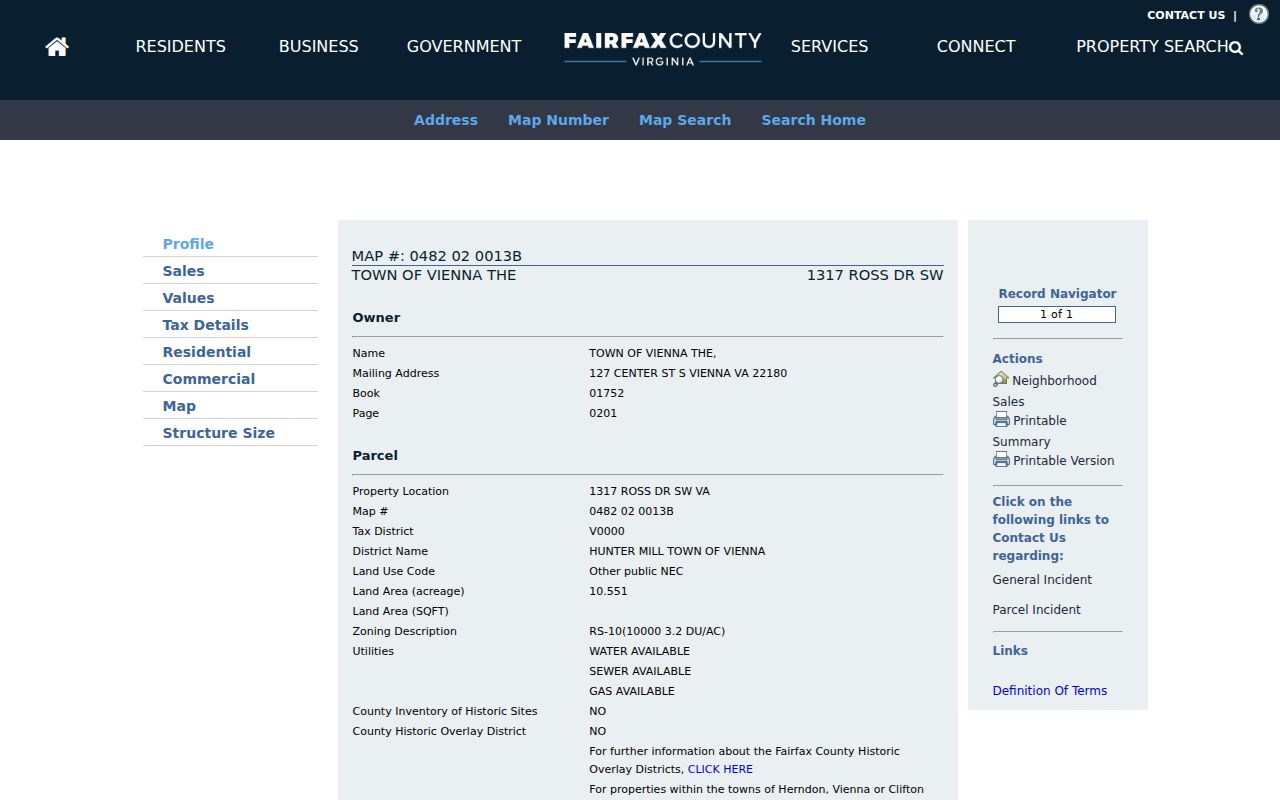
Use the image as a field checklist. If a field you need is absent, go to the office that maintains it rather than inferring from a neighboring entry.
Search Fields in iCare and Jade
Fairfax County's two parcel-finding tools take different inputs. iCare is built around the tax card. Jade is the county's map and analysis tool. The public help page lists the field order and basic behavior of each search mode. So a failed address match does not leave you guessing at the county's full data structure. For addresses, follow the county situs format. Try the house number with a short or abbreviated street type. For subdivisions, use Jade's autocomplete. A PIN search narrows as you type. Map Tips give one key attribute, and "View Additional Details" exposes more fields after selection.
| Portal and mode | Input | What it does |
|---|---|---|
| iCare: Address | House number and street name/type | Returns the DTA parcel card for a situs address. |
| iCare: Tax Map Reference | Fairfax PIN, such as 0482 02 0013B | Opens the exact tax parcel record. |
| iCare: Map Search | Map selection | Finds a parcel when the written address is not known. |
| Jade: Parcel or Address | PIN autocomplete; or house number, street, type | Highlights a parcel or address point on the county map. |
| Jade: Intersection or Subdivision | Two street selections; or subdivision autocomplete | Places a crossroads or recorded subdivision in view. |
Choose the Right Fairfax Search Key
The right Fairfax County search key depends on your question. Are you chasing one location or a named party? An address reads easily but can grow ambiguous near an independent city or town boundary. A tax-map reference is exact for the county roll. A person or company name works in the deed index, where exact spelling and legal form matter. Don't force an owner-name search into iCare. Its public screen offers no distinct name mode. Find the property first when you can. Copy the owner field exactly as it appears, then carry it into the recorded index. For an entity, search the exact legal name from the deed or the SCC filing. A trust or estate may be indexed under a trustee, executor, administrator, or successor fiduciary.
| Key | Best for | Fairfax County route | Limit to watch |
|---|---|---|---|
| Address | One known site | iCare, Jade, or LDS | Postal city may not equal jurisdiction. |
| Owner or party name | Finding a grantor, grantee, or multiple holdings | CPAN; iCare result field where shown | Withheld, misspelled, or entity-styled names. |
| Tax-map reference | Exact parcel match | iCare, Jade Parcel Search, CPAN cross-reference | Copy spacing and letter suffix carefully. |
Check Fairfax County Jurisdiction First
"Fairfax" is not one tax jurisdiction. The City of Fairfax stands apart from the county and pays no Fairfax County taxes. Vienna and Herndon mailing addresses make things murkier, since a parcel can carry county assessment and Circuit Court records while zoning, permits, or historic-district questions belong to the town. A ZIP code or a mailing label proves nothing about where the parcel actually sits.
Check jurisdiction with tools rather than guesses. Jade's political-jurisdiction layer and address points, the iCare town field, and the local office map settle the question together. A county assessment card can show a Vienna postal address while its town field reads "No," and that combination calls for a jurisdiction check, not an assumption. For town historic-district status, iCare itself directs users to confirm with the town.
When an Owner Name Is Hard to Match
Fairfax County DTA can leave an owner name off the online card at the owner's request. A blank field proves nothing. The parcel still has an owner of record somewhere. Use the situs address or tax-map reference to pull the card. Then pull the newest deed from CPAN. The deed's grantee field and legal description give far stronger cross-checks than any name-only match.
Names shift form, too. An LLC appears under its exact entity name. A trust may surface through its trustee. An estate may surface through an executor or administrator. Fairfax business filings in the State Corporation Commission's Clerk's Information System list an entity's registered agent and principal office. That helps when a name looks only partly familiar. That filing still does not replace the deed.
Shared names call for comparison. Line up the parcel, the mailing address, the legal description, and the prior conveyance. Do this before drawing a conclusion. A similar name in a separate case or business record never makes someone the owner of a Fairfax County parcel.
A withheld owner field is a privacy choice DTA honors. It is not a sign that the parcel sits vacant. Keep the map reference and situs address handy. When your purpose is naming the grantee in a conveyance, rely on the newest recorded deed. If card and deed disagree, note the deed date and recording reference. DTA refreshes its cards twice weekly but guarantees no transfer-to-card interval.
For a business owner, the State Corporation Commission's entity search confirms filing status and registered office. Corporate filings tell you who the legal person is. Only land records tie that person to ground. The recorded deed description remains the link between the legal person and the Fairfax parcel.
Search Fairfax Development Records by Address
Some questions concern work on the land rather than the tax card. The Fairfax County LDS Public Records tool searches an address for active construction sites and recent permits. It also returns zoning applications, comprehensive-plan amendments, and certificates of occupancy. Site plans and plats live in the Site Records Viewer. The address search traces development history. The recorded deed stays in Circuit Court land records.
Not everything is online. Some records take a request. Send a focused one to LDS or use the county VFOIA form. Give the site address and the parcel number if you know it. Add the record type and a useful date range. Ask narrowly. A public request can seek an existing permit or plan. VFOIA does not require staff to create a new report or research an open-ended question.
What a Fairfax Search Does Not Prove
A Fairfax County search connects an address to a parcel. It connects the parcel to its records. What it cannot do is prove that every lien has been released. It cannot show that the displayed owner is current after a closing. It also cannot confirm that a map line sits on the surveyed boundary. DTA's twice-weekly refresh is not a legal transfer timestamp. Jade's parcel geometry is reference data.
Read the whole instrument in CPAN for a recorded transfer. For an exact boundary, consult the recorded plat or deed and a licensed surveyor. Value is a separate question. Keep the tax assessment apart from a market appraisal. Each of these questions has its own custodian.
Search is not title work. Fairfax County search results are useful for lawful due diligence, but they are not a title guarantee, appraisal, or survey. Verify the controlling document with the office that holds it before making a purchase or land-use decision.
Search by Address, Owner, or Parcel
Every Fairfax County property search needs a key. A tax-map reference is the more exact next step. Owner names belong in the recorded-party trail, where they help you trace transfers or spot multiple holdings. Moving from one key to another cuts false matches, especially where a town, postal city, or business name muddles the address.
| Search Key | Best For | Where It Works | Watch Out |
|---|---|---|---|
| Address | One known property | iCare or Jade | Confirm town/city and street form. |
| Owner or party name | Recorded transfer or holdings trail | CPAN; iCare name field if displayed | Entity, trust, estate, or same-name issue. |
| Tax-map reference | Exact parcel record | iCare, Jade, CPAN cross-reference | Preserve spaces and suffix characters. |
Not a title search. A Fairfax County property search shows records held by public offices; it does not guarantee clear title, establish a surveyed boundary, or replace a title professional's review.